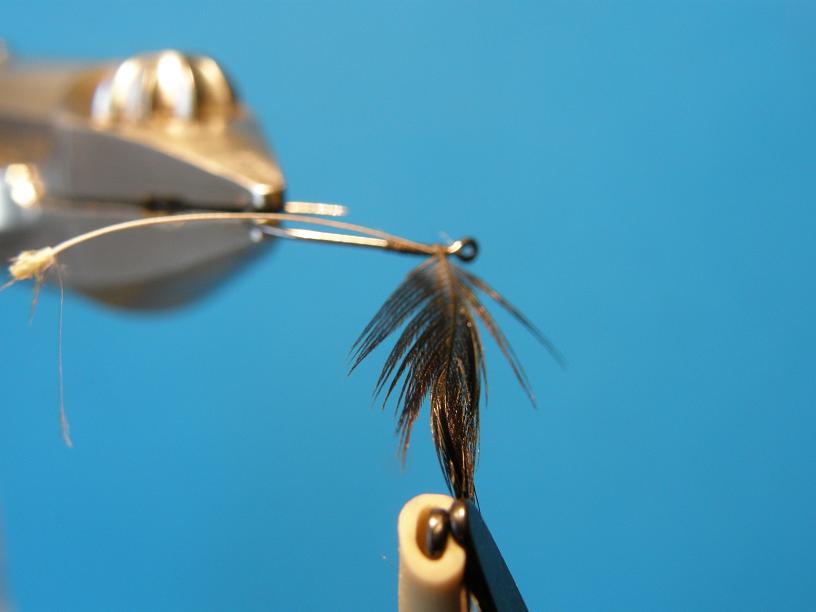
The other week I got the oppurtunity to do a "flyswap" with one of the great ones, Bob Mead. I have never before seen his stuff in flesh, but as many others I have admired his creations on the web. Bob is one of the pioneers in Realistic flytying, what a piece for my collection...
I´m offcourse really honoured to get this chance.
Bob Mead´s Lady bug
Today I made the flies that I shall send to Bob.. As the Hendrickson´s is starting to make it´s entrance at this time within the "Charmed circle of the Catskill´s", I choose to make Mr and Mrs of that mayfly.
Red Quill
Hendrickson
Once again my flies will be travelling over the pond without me following :-) Well, I will be there in November, hopefully I will meet Bob and all other of my heroes and legends.
A Flytyers quest of giving the flytyers and flyfishers of today and tomorow a chance not to forget about the Amazing heritage from the past.
lördag 16 april 2011
söndag 27 mars 2011
Southern Appalachian Flytying Championship
In January I sent a a set of flies to participate in a flytying competiton in the states The Southern Appalachian Flytying Championship. Last week i got the result, I found myself on third place, offcourse I´m honoured. The winner was Wayne Samson and on second place Mr Deer hair specialist Chris Helm, well done mates.. I got a really nice prize a fly tied by Mary Dette, "the Kaaterman" a glasdome to mount it in and also really nice print of my fly. There was also a 25$ check but that I asked them to send to the Catskill Flyfishing Museum.
We were supposed to tie two flies, one mandatory on "The Tellico Nymph". This fly kind of caught me, it was funny to play with something I never tied before. By the way.. thank´s Håkan for helping me with the materials I didn´t have in my stash..
Then there was the other fly.. Here I wanted something really special, something from my heart. So I choose my favourite fly "Quill Gordon" and added something to that, thought I would do a version of it to match the situation when you want a more boyant fly, to use when the water is a little rougher. I added a body hackle, not a full one though cause I still wanted to see the peacock quill properly. I simply stripped one side of the hackle and to make sure the hackle didn´t slip on the quill I added a thin layer of superglue before wrapping the hackle. Personally I think the fly looks really toxic and I can´t wait to try it out this coming season.
onsdag 9 mars 2011
The Coffin Fly
"The Coffin Fly" was first designed by Walt Dette and his friend Ted Townsend in the beggining of the 1930´s. Walt did over the years work on the pattern making several improvements, It is still today a popular fly in the Catskills. The fly is supposed to imitate a spent Ephemera Guttulata or more common named Green Drake the largest of the mayflies within the charmed circle of the Catskills.
söndag 6 mars 2011
American March Brown
The March Brown is a name of a fly that has been mentioned in fishing literature for hundred of years. The March Brown I tied here is not that old. The American March Brown was originated by Preston Jennings and he has it published in his book “A book of troutflies” as a imitation for the American March Brown. Mr Jennings was experimenting on how light refracts off a insect on the surface, and how the trout perceives such light, this and more made Mr Jennings to come up with this pattern, one of the more known Americna dry fly patterns.
His "A Book of Troutflies" was first published 1935 and was the first book that gave the American fly fisherman a good reference to American trout stream insects. Mr Jennings was a highly regarded angler and fly tier.
onsdag 23 februari 2011
Coachman
Although one of my absolute favourite flies to fish and tie are the Royal Coachman Fanwing I have never tied the fly behind it "The Coachman". After reading an article about one of my friends, the article described my friend and his favourite fly... and as I will meet him this weekend while tying at a fair in Dalarna I thought I should make him some.
The fly was first tied around 1830 by Mr Tom Bosworth. Tom was not only a great flytier but also a coachman to George IV, William IV and Queen Victoria. Personally I count this fly as one of the true classic dryfly´s. I´m looking forward to try this bug this coming spring, and I really enjoyed tying it.
lördag 19 februari 2011
Grey Partridge (Grey Watchet)
At the moment I´m in something who can be reffered to as a "Spidermode". Working on the script for one of my coming DVD´s, one of the two DVD´s will be about Spiders or North Country Flies. The DVD will not be about me sitting and telling people what´s right or wrong, it will be about the flies and how I tie them, about me and my view on flytying and to show that you don´t need to be a "procaster" to catch fish. More about this another day.
Grey Partridge or Grey Watchet
I´m thinking of putting this one in to the DVD. I like the apparence of it and it will suit the period of when we will be filming the fishingparts. The book of T.E Pritt "North Coutry flies" says that the fly works best at cold days, and in the evenings during June and July.
Recepie:
Wings: Hackled with a light feather from a Partridge´s breast.
Body: Straw-coloured silk.
Head: Peacockherl
1. Start with your thread behind the eye and wind 4-5 turns back, this will give you a nice foundation for the peacock herl that will be tied in later. Tie in your Partridge breast feather, backside up. Cut the excess material.
2. Wrap your thread in tight turns back to where the hook start´s to bend. Turn and wrap to just behind where the hackle is tied in.
3. Wind the hackle, I took two wraps on this fly. Catch the hackle with the thread.....
4. ...and work the thread through the hackle. Stop the thread behind the hookeye.
5. Tie in the Peacock herl.
6. Wrap the peacock herl around the thread to make yourself a "Peacock herl thread". You can offcourse wrap the herl as it is but this will leave a less durable Pecock herl head.
7. Give the head 4-5 turns of "Peacock herl thread" and finish it up with a 3-4 turn of Whipfinish, give the thread some extra wax before the whipfinish, that will make it a little more durable. Now we have a classic North Country Fly ready for those cold early summer night´s..
söndag 13 februari 2011
Stewart Black Spider
The "Stewart Black Spider" is one of my three favourite Spider patterns, both to tie and fish. So this afternoon I tied some "Stewart black Spider" one of three "most killing" spiders from W.C Stewart´s book the "The Practical Angler", a fly that´s more than 150 years old, and still going strong. W.C Stewart said "we were first shown it by James Ballie, and have never been without it on our line since".
3. Lay the thread on the inside of the featherstem and put together thread and feather with a hackleplier.
4. Twist feather and thread with the help of the hackleplier until it looks as on the picture. I use to help the fibers some with my fingers.
5. Wrap the "hackled thread" backwards 3-4 wraps and tie it off. Cut off the excess of the feather.
6. Make some 3-4 extra wraps of thread and whipfinish behind the hackle.
1. Start with your thread on the middle of the shank.
2. Wrap your thread to the hookeye, create a small head. Select a feather with a fiberlength equall to the shank and tie it in.
3. Lay the thread on the inside of the featherstem and put together thread and feather with a hackleplier.
4. Twist feather and thread with the help of the hackleplier until it looks as on the picture. I use to help the fibers some with my fingers.
5. Wrap the "hackled thread" backwards 3-4 wraps and tie it off. Cut off the excess of the feather.
6. Make some 3-4 extra wraps of thread and whipfinish behind the hackle.
Prenumerera på:
Inlägg (Atom)